





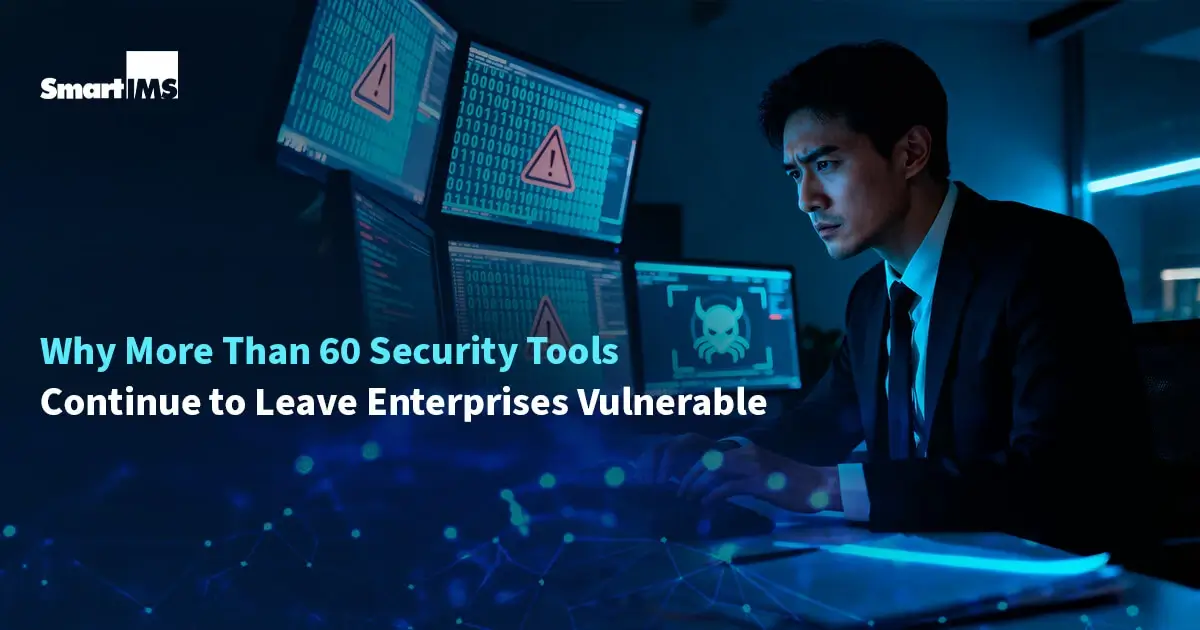
The modern enterprise has made significant investments in cybersecurity. Security information and event management (SIEM) systems, endpoint detection and response (EDR) solutions, vulnerability scanners, cloud security platforms, and identity platforms have been adopted to address the growing wide threat surface. As a result, most enterprises today use 60 or more security solutions.
Despite these efforts, the number of security breaches has continued to increase. The problem is not a lack of tools but rather the problem of tool sprawl.
How Tool Sprawl Creates Coverage Gaps
Tool sprawl
Security solutions are often implemented in reaction to specific risks or requirements. As standalone solutions, they work well; together, they can provide disjointed views.
Alerts are distributed through various means. Telemetry is warehoused in silos. Correlation is done manually or not done at all. Security operations centers spend more time on tool management than on threat response. This leads to a higher chance of missing important alerts.
Blind spots usually exist between tools and not within tools, thus resulting in coverage gaps that can be exploited by attackers.
The Real Cost of Fragmented Security Stacks
Apart from the costs of licensing, the problem of tool sprawl also creates substantial financial burdens. The cost of operation increases as teams have to manage various consoles. Alert fatigue becomes a common problem as detection and response become difficult. Strategic knowledge is reduced, and CISOs cannot answer the simple question: “Do we have visibility into our environment?”
For many companies, the truth is still no.
Why Consolidated Monitoring Represents the Most Effective Path Forward
The healthcare industry has been experiencing significant
The healthcare sector is experiencing constant change.
The present effectiveness of security is less dependent on the amount of tools available and more on the quality of data integration.
Consolidated monitoring allows all the signals from the security stack to be integrated into one location, which allows for better correlation and decision-making. Analysts can focus on high-risk events rather than chasing alerts across multiple dashboards.
This approach also simplifies complexity, enhances response consistency, and helps organizations in managing costs without affecting their security posture.
In Smart IMS, we believe that this paradigm shift is imperative because it will enable enterprises to optimize security spending, improve security monitoring strategies, and integrate disjointed security environments into a unified security operation.
From Tool Accumulation to Security Maturity
The future of cybersecurity is not about building more tools, but about simplifying, integrating, and optimizing what is already available. Organizations that make the transition from tool accumulation to monitoring can expect improved visibility, fill gaps in coverage, and quicken response times, thus making security a business enabler rather than a burden.